
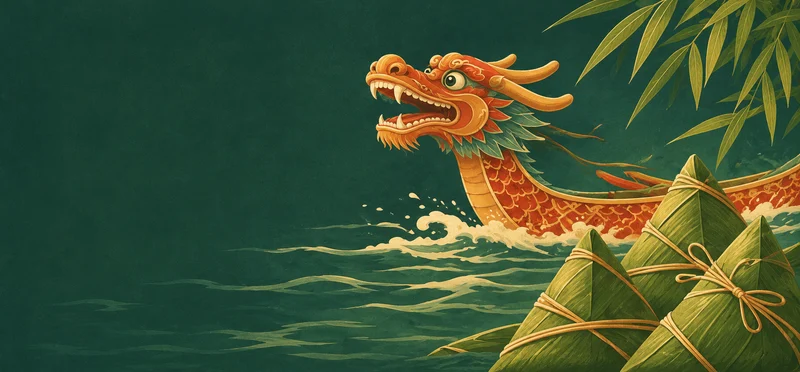
Finding Duanwu in the calendar
The Dragon Boat Festival is called Duanwu in Mandarin and Tuen Ng in Cantonese. UNESCO's heritage entry places it on the fifth day of the fifth lunar month and documents celebrations among several ethnic communities. It was inscribed on UNESCO's Representative List of the Intangible Cultural Heritage of Humanity in 2009. That listing recognises a living cultural practice carried by people.
A numbered lunar month does not correspond to the same numbered month in a Gregorian calendar. To plan a visit, first find the festival's local calendar date, then check the organiser's programme. A sports event associated with the season may take place on a different weekend. The holiday date and a race timetable answer different practical questions.
An original way to approach the festival
Think about three scales of participation. At a household scale, ask about a food or object someone prepares. At a neighbourhood scale, look for the people who maintain a boat or organise a gathering. At a public-event scale, consider how spectators and competitors meet. This framework is our editorial tool for reading the examples in this guide.
A race photograph may catch your attention first. Keep looking beyond the finish line. Who prepared the boat? Which association is named in the programme? What else happens nearby? These questions give you a route from a striking image into the relationships that make an event possible. They also help you describe precisely what you have actually seen.
Qu Yuan, Chu and a story of remembrance
The best-known festival story concerns Qu Yuan, a poet and official associated with the state of Chu. Chu was one of the competing states of ancient China. The term Warring States describes the centuries of rivalry before Qin unified China in 221 BCE. Academia Sinica's historical overview explains how regional rulers competed as the older Zhou political order weakened. This was a world of several courts and allegiances.
In the traditional account retold by Hunan’s culture and tourism department, Qu Yuan is exiled from court and grieves for his state. He dies by drowning in the Miluo River. Local people search for him in boats and scatter rice to keep fish from his body. Later retellings connect these acts of care with boat racing and zongzi. This is a traditional explanatory story linking remembrance, boats and food. The story's details should be presented as inherited narrative, not as a verified report of the first dragon boat race.
The Metropolitan Museum of Art's discussion of a narcissus painting shows another afterlife of Qu Yuan's reputation. It connects the flower's imagery with the poet and a later poem expressing loyalty. His cultural presence extends beyond one annual event.
Original reading questions
What qualities does a community choose to remember in a person? How can a food or a flower carry that memory? Try these questions before asking whether every detail of a legend literally occurred. You can value the story's emotional importance while checking historical claims separately. When explaining it to children, focus on care, memory and the support people offer one another. Allow questions and avoid turning a tragic ending into an example to imitate.
Boats, rice parcels and wishes for well-being
A dragon boat brings people into coordinated movement. Singapore's tourism board describes a standard crew with twenty paddlers, a drummer and a helmsman who steers. Boat formats vary, so check the event's rules before treating those numbers as universal. For a first-time spectator, watch the relationship between the drumbeat, paddles entering the water and the boat's direction.
Zongzi are rice parcels cooked in leaf wrappers. Hong Kong's tourism board describes bamboo-wrapped glutinous rice with both sweet and savoury fillings. The wrapper is opened before eating. If buying one for the first time, ask about its filling and any ingredients you avoid. The word glutinous describes the rice's sticky texture. It does not itself identify everything in the filling.
Hunan's festival account also records aromatic sachets and hanging plants. Here they are presented as cultural expressions of wishing for protection and well-being. The historical belief attached to an object does not establish a medical effect.
An original observation exercise
Choose one action and describe it using verbs. Paddlers coordinate, a cook folds, a relative gives a small gift. Then ask what skill or relationship the action makes visible. This keeps your attention on people rather than treating their possessions as decorative curiosities. If you share a food image, include its name and the information the maker provides. A simple, accurate caption can teach more than an invented explanation of symbolism.
Miluo and Tai O, different waterside traditions
In Miluo, Hunan, a provincial government report documents a June 2024 festival gathering beside the Miluo River. The programme included remembrance of Qu Yuan and a dragon boat launch ceremony before racing. Naming the river and province makes this a particular place that a reader can locate on a map. Hunan is an inland province, well away from Hong Kong’s coast.
In Tai O on Hong Kong's Lantau Island, the Intangible Cultural Heritage Office describes a water parade organised by three fishermen's associations. Dragon boats tow sacred sampans carrying deity statues through the waterways, after temple visits. The statues later return to their temples. This is a religious procession with a local sequence of duties. Watching only for a competitive finish would miss what the participants are doing.
Original comparison questions
Place the two examples side by side. Who or what receives attention? Which people organise the activity? How does the waterway connect places and participants? Write your answers using only information supported by the two accounts. Leave unknown details as questions.
Local differences make the festival more understandable when they are named carefully. A precise explanation can say which community a practice belongs to, how it is described and which source documents it. If you visit, listen to the host's preferred explanation. Your first account may need revision after learning more. That is a normal part of encountering a living tradition, whose members can also hold different views about its meaning.
Contemporary racing and community teaching
The Singapore Dragon Boat Association's festival page documents a contemporary competition at Bedok Reservoir with entries across multiple race categories. It describes participation from clubs, schools, corporate crews and high-performance teams. This organiser's account offers a specific example of dragon boating as structured sport in a multicultural city. Event details should be checked afresh when planning a visit.
A different documented example is the 2025 multimedia exhibition on Tai O's water parade listed by Hong Kong's Lantau Conservation Fund. The programme used objects, models, photographs and other media, and included a parent-child paper dragon boat workshop. This provides a real example of teaching a local tradition through an exhibition and an accessible craft activity.
Original interpretation
Together, these examples show two routes into participation. One asks people to learn coordinated athletic skills and competition rules. The other offers a way to look, ask questions and make something with guidance. A newcomer can choose an entry point that suits their interests and abilities.
It is worth asking who receives recognition in the resulting story. Race photographs often foreground athletes. An exhibition may also make organisers, boat maintenance and inherited knowledge visible. When sharing a community event, name the organiser and credit the people whose work you can identify. Explain what you observed, and separate it from your own interpretation. This helps future readers find the original event and understand why it mattered to the people involved.
Your first visit, meal or learning session
Begin with a choice. You might watch a race, taste a zongzi or explore the story behind a procession. Hong Kong's tourism board describes both international racing and smaller neighbourhood events. Choose a published public programme and check the organiser's current guidance on access. A procession may include moments intended primarily for its own community.
Original activity designed for this guide
- Before a visit, write down the place, organiser and type of event. Decide whether your main question concerns food, teamwork or local ritual.
- During the event, record three concrete observations. For example, describe an action you can see and identify where you are standing. Ask permission before photographing identifiable people at close range.
- Afterwards, connect one observation to a source in this guide. Add a question that would require more local knowledge to answer.
- If sharing online, include the festival's local name, location and date. Credit the organiser, and label your own reflections as personal impressions.
This activity is an original educational exercise from Festival Atlas. It is designed to support careful observation and respectful sharing.
For a first meal, ask the seller or host to explain the wrapper and filling. For a first paddling session, use an organised introductory activity and follow the instructor's guidance. If a ritual interests you, ask a host when questions are welcome. You can learn a great deal by paying attention to how people explain the work they are doing together.
Materials and useful words
Bring a notebook or phone for observations. For the tasting option, have a cooked zongzi, a plate and cutlery; remove the leaf wrapper and follow the seller’s serving instructions. Ask “这是什么馅?— Zhè shì shénme xiàn?” (“What is the filling?”). “谢谢邀请 — Xièxie yāoqǐng” means “Thank you for inviting me.”
Practices and the meanings they can carry
Dragon boat racing
Coordinated movement can make collective effort visible.
Sharing zongzi
Making and giving food can connect skill, hospitality and remembrance.
Aromatic sachets
A small object can convey a wish for someone's well-being.
Tai O water parade
A local ritual connects associations, temples and waterways.
Glossary
- 端午
- The Mandarin name of the festival observed on the fifth day of the fifth lunar month.
- 屈原
- A poet associated with Chu who is commemorated in a widely told festival story.
- 楚国
- An ancient state that existed before China's unification under Qin.
- 战国
- The era of competing states before Qin's unification in 221 BCE.
- 龙舟
- A dragon-decorated boat used in racing and, in some communities, ritual activities.
- 粽子
- Rice cooked in a leaf wrapper, with fillings that vary.
- 香囊
- A small aromatic pouch that can express wishes for well-being.
- 游涌
- Parading through waterways, used here for Tai O's dragon boat ritual procession.
Sources & further reading
Chapter references connect each section with its sources. Folklore is presented as a particular telling, and suggested learning activities are identified in the text.
- UNESCO · Dragon Boat festival
- Singapore Tourism Board · Guide to the Dragon Boat Festival
- Academia Sinica Museum · Eastern Chou historical overview
- Hunan Culture and Tourism Department · Dragon Boat Festival traditions
- Metropolitan Museum of Art · Zhao Mengjian, Narcissus
- Hong Kong Tourism Board · Dragon Boat Festival customs and events
- Hong Kong Intangible Cultural Heritage Office · Tai O Water Parade
- Singapore Dragon Boat Association · Festival competition at Bedok Reservoir
- Lantau Conservation Fund · Tai O exhibition and workshop, 2025
- Hunan Government · Duanwu cultural event in Miluo, June 2024