
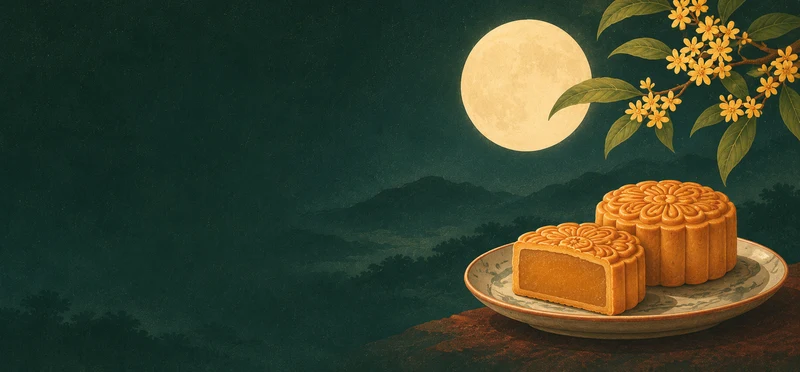
Why a round moon can mean reunion
Mid-Autumn is observed on the fifteenth day of the eighth month of the traditional Chinese calendar. Singapore's National Heritage Board describes family gatherings with mooncakes, pomelos, and tea, alongside children's lantern play. For a newcomer, these familiar actions provide an entry point into a festival with several layers of meaning. People can share food, remember someone far away, and look upward during the same evening.
Our suggested way to understand reunion is to start with the action of including someone. A complete circle offers a useful image, but people make belonging through invitations, conversation, and attention. You do not need a perfect family photograph to ask who should have a place at the table. This is a teaching interpretation of the theme, not a rule every household expresses in identical words.
Calendar and sky are different kinds of information
The Hong Kong Observatory's 2025 notice placed the exact full moon on the day after the festival. This concrete example shows why a calendar celebration need not coincide with the astronomical instant. Avoid assuming the festival guarantees the year's largest or most perfectly full moon.
For your own gathering, check the date, local moonrise, and weather separately. Even if clouds interrupt the view, a conversation and shared food can still carry the reunion theme. The sky gives people a subject for attention, while their choices give that attention a social purpose.
Chang'e's ascent, with the version made clear
The British Library learning-resource version
Ten suns appear together and scorch Earth. Hou Yi shoots down nine, but the heavenly ruler punishes him and his wife Chang'e by making them mortal. Seeking their return to immortality, Hou Yi obtains an elixir from the Queen Mother of the West. It must be shared. Chang'e takes all of it and rises to the moon. Hou Yi cannot bring himself to shoot her. She remains there, missing him, with a medicine-pounding rabbit and the woodcutter Wu Gang. The resource ends with Hou Yi returning to heaven and visiting her annually. That ending belongs to this telling.
The National Museum of China separately describes a Tang-dynasty moon-palace mirror featuring Chang'e, a rabbit, and an osmanthus tree. It helps connect story characters with visible art. The museum's summary and the Library's longer narrative should be read as identifiable accounts, rather than assembled into a single supposedly original text.
Our suggested reading questions begin with the elixir. What does each character hope it will solve? What problem does its use create? A promise of endless life does not automatically bring togetherness within this story. That tension offers one way to connect a tale of separation with a festival about reunion.
If a family tells a different version, record the difference respectfully. Identify whose account you heard, with permission. You can compare motives and endings without declaring one household's memory mistaken merely because another publication tells the story differently.
Moon-viewing and sharing create a rhythm
Singapore Tourism Board describes mooncakes and tea shared with family and friends, along with lantern gatherings. Its examples include lotus-paste mooncakes and newer flavours. This combination introduces customs through things people can do together. Looking, tasting, talking, and walking give the evening a rhythm without requiring a single script.
Suggested ways to notice meaning
Try placing one mooncake on a plate before dividing it. Ask what changes when a single object becomes several portions. The cake remains one shared reference even when everyone receives a different piece. This is our suggested demonstration of sharing, not evidence that every family performs a formal cutting ritual.
For tasting, read the ingredients and offer small portions. Invite participants to describe texture before deciding whether they like it. Someone unfamiliar with a filling may find words such as dense, smooth, flaky, or chewy more helpful than a judgement of authenticity. If a guest cannot eat the cake, include them through another food or through conversation.
For moon-viewing, take a few minutes to observe before taking a photograph. Compare what eyes and cameras reveal, then return to the people around you. We suggest asking whom each participant would like to send a greeting to. The transition from seeing something together to thinking about someone apart makes the reunion theme understandable through an ordinary action. It also leaves room for a quiet celebration.
Three customs, three kinds of connection
The Heritage Board’s Singapore record describes sharing mooncakes, looking at the moon and children playing with lanterns. A plate joins people around food; a shared view gives distant friends something to discuss; a lantern walk lets children join the evening. These are our interpretations of the documented activities. Lantern play can accompany moon-viewing without becoming the same occasion as Lantern Festival, which falls in the first calendar month.
Hong Kong's Tai Hang and Singapore
Tai Hang, Hong Kong
The Tai Hang Fire Dragon Heritage Centre records a community dance held over three nights around Mid-Autumn, beginning on the fourteenth night of the eighth month. A large incense-covered dragon moves through the streets to gongs and drums. The centre associates the practice with prayers for safety and peace. Here, coordinated neighbourhood action is especially visible.
Singapore
Singapore Chinese Cultural Centre's festival panels distinguish mooncakes associated with Cantonese, Teochew, and Hokkien communities. They also document lantern activities in local public spaces. This gives a reader two scales of variation to examine, namely differences between foods and differences between the settings in which people meet.
Our suggested comparison is to ask what people must coordinate in each example. A street procession needs a shared route and timing. A tasting needs portions and explanations. A lantern activity needs a place where people can move together. These observations are a way to read the examples, not a claim that the two places each have only one tradition.
When browsing photographs, keep their captions attached. A dragon image labelled Tai Hang and a lantern image labelled Singapore can teach distinct local practices. Without those labels, they can become a vague collection of festive decorations. Place names help readers understand how a widely shared festival acquires a particular community's scale, materials, and public spaces.
A documented modern festival classroom
Singapore Chinese Cultural Centre and Singapore Chinese Orchestra jointly organised Mid-Autumn Family FUN in 2026. The published programme listed mooncake tasting, lantern walks, moon and stargazing, craft activities, and cultural performances, with English and Mandarin as event languages. This is a real organiser's programme, which demonstrates how several learning formats can coexist within one contemporary celebration. It should not be treated as a current booking notice for a later year.
Our reading of that programme is that a festival can give people different routes into participation. A child might begin with a lantern, another visitor with music, and someone else with a question about the sky. None of these starting points requires knowing all the legends first. A well-designed gathering can let a visitor move from curiosity to a more specific question.
Suggested questions for evaluating an event
Does the programme tell visitors what they can make, hear, or observe? Does it distinguish a performance from a workshop? Does it provide enough language and accessibility information for a newcomer to participate comfortably? These are our planning questions, not statements that every listed event already meets every need.
For a community post, describe one actual activity you joined and what the organiser explained. Include the venue and year, then identify any interpretation as your own. This helps an overseas reader recognise a living practice without turning one enjoyable afternoon into an unsupported account of everyone's experience.
Make room for people near and far
The National Heritage Board's account places family bonding among the festival's important activities. Our suggested first gathering translates that theme into a small, welcoming plan. It is an educational adaptation. A couple of people and a shared snack are enough to begin, and a remote guest can participate through a message or a call.
- Set a comfortable time. Check the local moonrise if you plan to go outside, but let conversation continue if clouds obscure the view.
- Introduce the theme. Ask what reunion means to the people attending. Allow someone to pass if the subject feels personal.
- Share food thoughtfully. Read ingredients, cut manageable portions, and provide another option for anyone who needs one. Explain that tasting is an invitation.
- Tell a clearly identified story version. Afterward, ask how its ending changes the feeling of separation. Invite a different remembered version without forcing the two accounts into agreement.
- Include someone at a distance. Send a short greeting and explain why that person came to mind. Check time zones before calling.
As a suggested creative activity, draw three linked circles labelled moon, table, and people. Add one action to each, such as observing, sharing, and contacting. This diagram turns the theme into something participants can actually do.
If you share your gathering online, caption it as your own celebration, give the place and year, and credit any source used for storytelling. A modest, accurately described experience offers future visitors a clearer invitation than a claim to represent every Mid-Autumn tradition.
Materials and useful words
Prepare a shared snack, plates, drinking water and paper for the circle drawing. Say “中秋快乐 — Zhōngqiū kuàilè” (“Happy Mid-Autumn Festival”) or “一起尝尝吧 — Yìqǐ chángchang ba” (“Let’s try some together”). Offer a portion and let the guest choose.
From looking at the moon to including someone
A shared view
Moon-viewing gives people a common object of attention. Check local conditions before planning.
A shared table
Dividing food creates an opportunity to make room for another person.
Remember someone apart
A greeting or call can include someone who cannot join in person.
Express reunion
Observing, sharing, and contacting turn an abstract theme into actions chosen by the participants.
Glossary
- 中秋
- The Mid-Autumn Festival on the fifteenth day of the eighth traditional calendar month.
- 团圆
- Reunion or coming together, a central theme explored through family and social connection.
- 赏月
- Taking time to look at and appreciate the moon.
- 月饼
- A festival pastry with different local styles and fillings, often shared with others.
- 嫦娥
- The moon-associated figure whose ascent has several narrative versions.
- 后羿
- The archer and Chang'e's husband in the story version presented here.
- 玉兔
- The Jade Rabbit, often represented pounding medicine in moon imagery.
Sources & further reading
Chapter references connect each section with its sources. Folklore is presented as a particular telling, and suggested learning activities are identified in the text.
- Singapore National Heritage Board, Roots — Mid-Autumn Festival
- Hong Kong Observatory — Moon-watching tips, 2025
- British Library, International Dunhuang Programme — Chang-E, or the archer and the Moon goddess
- National Museum of China — Bronze Mirror with Design of a Scene in the Moon Palace
- Singapore Tourism Board — Mid-Autumn Festival
- Tai Hang Fire Dragon Heritage Centre — Community heritage and the annual dance
- Singapore Chinese Cultural Centre — Mid-Autumn the SINGAPO人 Way exhibition panels
- Singapore Chinese Cultural Centre — Mid-Autumn Family FUN 2026 programme