
One name, a season and a family observance
Qingming means clear and bright. It names both a solar term and a festival associated with remembering the dead. A solar term is a marker in the Sun's annual apparent journey across the sky. The Hong Kong Observatory explains that twenty-four such markers divide that journey into equal fifteen-degree sections. Qingming begins at solar longitude fifteen degrees, after the spring equinox. This helps explain its position near early April, rather than a fixed numbered day in a lunar month.
The distinction matters when reading a Chinese calendar. Months follow the Moon, while solar terms keep track of the seasonal year. These are two kinds of information displayed together. For a beginner, imagine one calendar with a monthly rhythm and a separate seasonal ruler alongside it. The ruler is our teaching analogy, not a traditional diagram.
An original reading lens
Read the festival through three questions. What is happening in the landscape? Who is being remembered? How does a family make time to gather? These questions connect weather, memory and relationships without assuming that every household follows one ritual script.
A date tells you when to look, but it cannot tell you how a particular person feels. Someone may approach Qingming with grief, gratitude, routine responsibility or several feelings together. Leave space for those possibilities when discussing the festival with a friend. Ask whether they observe it before asking how they celebrate it.
How remembrance and spring came together
Qingming is best understood through layers of practice. Singapore Chinese Cultural Centre's Culturepaedia connects Qingming grave visiting with the Tang dynasty, 618–907, and Song dynasty, 960–1279. Those dynasty names describe successive historical periods, separated from us by roughly a thousand years or more. They help place a changing custom in time.
Shanghai’s account of qingtuan also discusses Cold Food, called Hanshi, a tradition of eating previously prepared food without lighting a cooking fire on that occasion. Its proximity to Qingming provides useful background for their later association. We do not need to make a supernatural story the centre of a festival about family memory.
Pictures as another kind of story
The National Palace Museum catalogues a scroll attributed to Qiu Ying titled Up the River During Qingming. Its listed subjects include merchants, travellers, bridges, shops and spring scenery. Such a museum object opens a different doorway into the season, through imagined or represented everyday activity. A painting is an artwork with its own maker and viewpoint.
Jie Zitui: a Cold Food legend
China Today’s account from Jiexiu, Shanxi, retells a legend set in the Spring and Autumn period, before the Warring States. Jie Zitui helps the exiled prince Chong’er. After becoming ruler of Jin, Chong’er seeks him, but Jie retreats with his mother to Mount Mian. The ruler orders a fire to force them out; both die. In remorse, he orders food to be eaten without cooking fires in their memory. This is a later explanatory legend about Cold Food, not proof of a single origin for all Qingming practices.
What a visit can involve
Singapore's National Heritage Board documents visits to graves and columbaria, where urns containing ashes are kept. Families may clean the site, bring food, flowers or tea, and bow or make other gestures of respect. Its account describes different offerings among dialect communities. This is a documented setting that helps explain actions you may encounter, rather than a checklist for every Chinese family.
The word ancestor can mean a relative from an earlier generation. For a newcomer, the most accessible starting point is the relationship involved. Someone makes a journey, tends a place and gives attention to a person who has died. Particular beliefs about offerings or the afterlife deserve explanation from the family practising them.
Original visitor guidance
If invited, ask your host what assistance would be welcome. Carrying water, helping an older relative walk, or waiting quietly may be more appropriate than copying an unfamiliar gesture. Ask before taking photographs, especially if names, portraits or grieving people would be visible. An invitation to attend does not automatically include permission to publish.
Allow silence. You do not have to turn every object into a question while a ceremony is taking place. Afterwards, you might ask whether a food belonged to someone's favourite meal, or whether a younger relative learned a story that day. These suggested questions are our own learning guidance. They make room for personal meaning without asking anyone to explain their entire family history to a visitor.
Two seasonal practices beyond a memorial visit
Shanghai’s guides describe taqing, a spring outing, and qingtuan, green rice-flour cakes associated with this season. An outing turns attention towards a changing landscape; a cake makes seasonal food something to share. These meanings are our reading of the examples. For a Shanghai example, follow the qingtuan-making heritage record; for a walk, observe local plants rather than expecting the same spring weather everywhere.
Shanghai and Singapore, different local textures
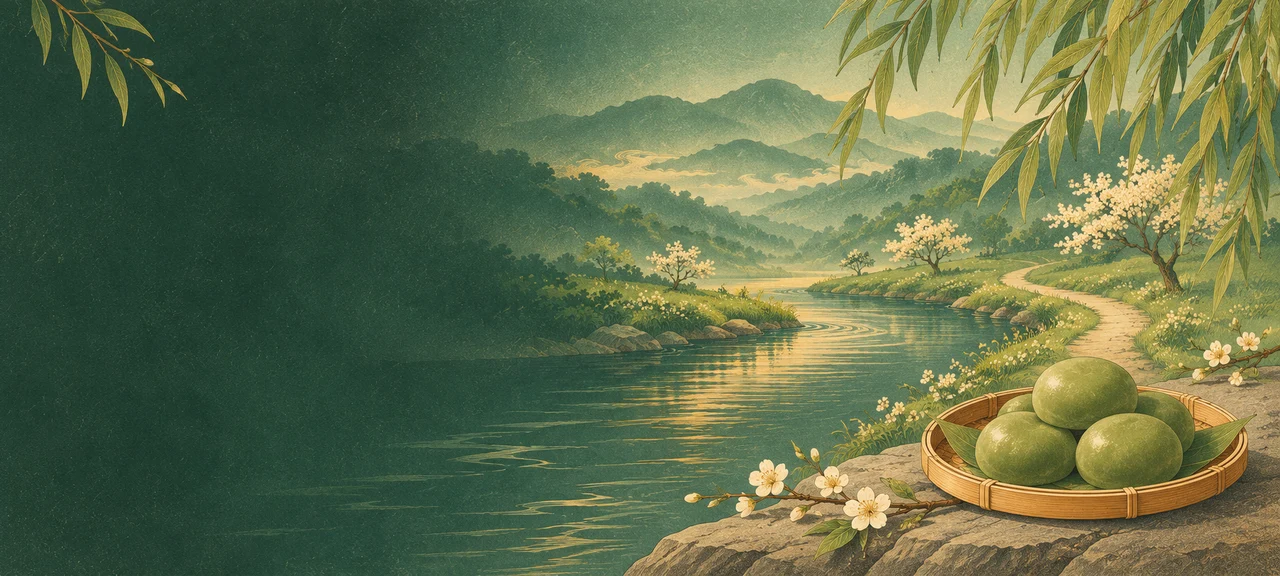
In Shanghai and the wider Jiangnan area south of the lower Yangtze, green rice cakes called qingtuan are associated with Qingming. Shanghai's government describes a chewy rice-flour exterior coloured with herbs and fillings ranging from red bean paste to savoury combinations. Its heritage page identifies qingtuan-making as municipal intangible cultural heritage. A seasonal snack can therefore lead to questions about craft as well as flavour.
In Singapore, Culturepaedia records specific differences among Chinese dialect communities. Teochew families have used coloured paper weighted with cockle shells at graves, while Hokkien families have used rectangular coloured paper held by stones. These examples describe inherited practices in that setting. Individual families may choose differently.
An original comparison method
Make two columns headed Shanghai and Singapore. Under each, note one named object and the action associated with it. Add a third column for questions you cannot answer from the sources. Perhaps you want to know who makes a food, who buys it, or how a family explains an offering. Leaving a space for uncertainty is part of learning.
Geography and language give useful starting points, but a region contains many households and changing circumstances. Avoid using one friend's account to judge everyone from the same place. A more precise caption for a shared image would name the place and practice actually shown. If that information is unknown, say so. Precision gives a reader something concrete to learn from.
A living season in contemporary cities
A concrete modern example comes from Shanghai's Xuhui district. In March 2025, the municipal government's English website published qingtuan tasting routes, including Tianyaoqiao Road and a route linking the West Bund, Long Hua Hui and Longhua Temple. This is a dated example of a public-facing seasonal food programme, not a promise that a particular shop or route will operate every year.
Museums offer another form of access. The National Palace Museum and River City Bangkok presented a new-media exhibition from October 2018 to February 2019 using an animated Qingming riverside scroll. Its stated theme connected historic riverside life with Bangkok's river setting. That specific exhibition has ended, but its record shows how a historical image can become material for cross-cultural learning.
Original interpretation
These examples invite us to consider the different spaces in which a festival becomes visible. A bakery makes seasonality tangible through taste. A museum provides images and labels for close looking. A family's remembrance may remain private. Each setting offers a different degree of access.
For someone living overseas, a distant ancestral place may be difficult to reach. If you are sharing your own experience, describe the choices your family actually makes and the circumstances behind them. A short, situated account is more informative than a claim about what all modern families do. Explain whether you are describing a personal practice, a public event or something learned from a museum.
A thoughtful first encounter
You can begin with a spring walk and careful reading. Shanghai's official Qingming outing guide describes heading outdoors as a seasonal custom. Take the actual conditions where you live as your starting point. A park in a different climate may look unlike a Chinese spring landscape, which can become an interesting observation to record.
Original activity designed for this guide
- Choose a short, accessible route and spend ten minutes noticing light, plants and sounds. Write three observations without making claims about an entire region.
- If you wish, think of someone whose care or knowledge shaped your life. Write one specific memory, keeping it private unless you want to share it.
- Explore a museum object or a sourced account of Qingming. Record the institution and one question you still have.
- If you share a photograph, explain where it was taken and what it shows. Obtain permission from identifiable people and keep private memorial details out of a public post unless the family agrees.
This is an educational activity created by Festival Atlas. It is an invitation to observe and reflect, rather than a claim to reproduce a traditional ceremony.
If a friend invites you to their family's observance, follow their guidance about timing, clothing and participation. You can thank them for including you and offer practical help. Afterwards, compare what you learned with the source you read. Notice both the connection and the differences. Learning becomes more accurate when another person's particular experience retains its own shape.
Materials and useful words
For this suggested walk, bring paper, a pencil and comfortable shoes. Ask “我可以帮忙吗?— Wǒ kěyǐ bāngmáng ma?” (“May I help?”). At a private remembrance, follow the family’s tone; a cheerful holiday greeting may not suit the moment.
Season, remembrance and an outing
Solar term
Qingming marks a position in the solar year after the spring equinox.
Family remembrance
A seasonal gathering can make time to tend a memorial place and remember relatives.
Spring outing
Attention can turn outward to the landscape and the people accompanying us.
Glossary
- 清明
- Clear and bright, the name of a solar term and an associated remembrance festival.
- 节气
- One of twenty-four seasonal markers based on the Sun's apparent annual motion.
- 扫墓
- Visiting and tending a grave while remembering the deceased.
- 踏青
- Going outdoors to enjoy the spring landscape.
- 青团
- Green rice-flour cakes associated with spring in Jiangnan, often filled.
- 寒食
- Cold Food, a neighbouring observance historically associated with Qingming.
Sources & further reading
Chapter references connect each section with its sources. Folklore is presented as a particular telling, and suggested learning activities are identified in the text.
- Hong Kong Observatory · The 24 Solar Terms
- Singapore Chinese Cultural Centre · Qing Ming Festival
- National Palace Museum · Up the River During Qingming, Qiu Ying
- Singapore National Heritage Board · Qing Ming Festival
- Shanghai Government · Qingtuan, a taste of spring
- Shanghai Government · Technique of Making Qingtuan
- Shanghai Government · Xuhui qingtuan tasting routes, 2025
- National Palace Museum · Bangkok new-media exhibition, 2018–2019
- Shanghai Government · Spring outing for Qingming
- China Today · Jiexiu’s Cold Food Qingming Customs, 2023