
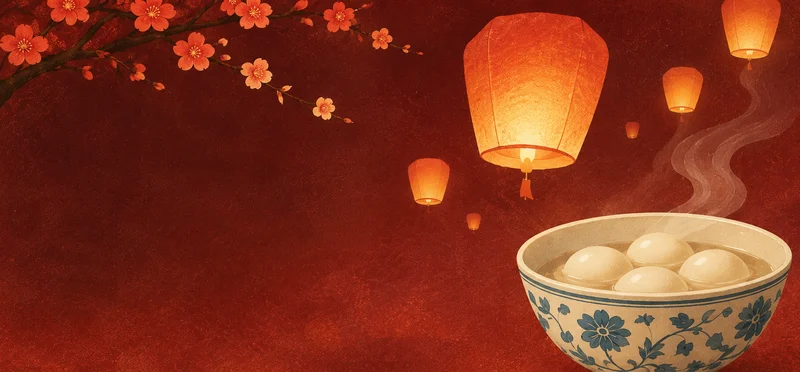
The first month's fifteenth night
Lantern Festival, or Yuanxiaojie, falls on day fifteen of the first month of the Chinese calendar. Shanghai's official cultural guide presents it as the final major occasion of the Spring Festival season. It is associated with the new year's first full moon. Yuan points to the beginning or first month; xiao means night. Together the name refers to the new year’s first full-moon night.
The date belongs to the Chinese calendar. The Hong Kong Observatory explains that this calendar combines lunar months and a solar framework, using leap months to keep the system aligned with the seasons. Consult a conversion table for the year you need. A date quoted in an older event report belongs to that edition.
Learn to recognize the setting
Shanghai's guide names lantern-viewing, riddles, and glutinous rice balls among the festival's familiar activities. Together they offer three different ways to participate. You can look closely at a crafted object, use words to solve a puzzle, or share food at a table.
The following is an editorial reading method for beginners. Ask which of those activities an event emphasizes, then find out who organizes it and who takes part. A food workshop and an outdoor light display can introduce different aspects of the same occasion.
Keep the calendar date separate in your notes from an event's opening period. This makes it easier to read an announcement accurately and to understand why a festival-themed exhibition may be available on several evenings.
Why lights carry so many stories
A tale of danger and ingenuity
A Jinan University cultural-heritage resource recounts a folk legend about a heavenly bird killed by hunters. The heavenly ruler plans to burn the human world, but people receive a warning. They use lanterns and fireworks to create the appearance of fire and escape destruction. This is a legend, with supernatural characters and a dramatic solution.
Our interpretation is that the tale gives shared action a memorable form. People turn a frightening prospect into an occasion for collective light. You can discuss that narrative pattern without assigning the story a proven founding date or treating its heavenly figures as historical witnesses.
Centuries of change
Shanghai's guide places the flourishing of lantern traditions in the Tang (618–907) and Song (960–1279) dynasties. This time span helps explain why a single origin story is insufficient to describe a celebration shaped across centuries.
Historical pictures ask different questions
Smithsonian's guide dates Palace Women and Children Celebrating the New Year to the fifteenth or sixteenth century, during the Ming dynasty. It identifies a colorful ball and market puppets with activities of the Lantern Festival. The painting combines several moments from the wider New Year season in a single scene.
That combination is a helpful lesson in reading images. A painting can organize time for its viewer. Begin by looking for separate actions, then consult the museum's explanation before deciding what each means.
For an original classroom exercise, put “folk narrative” and “dated object” on two cards. Under the first, write what the story expresses. Under the second, record the object's date, materials, and setting. Compare the kinds of knowledge the two provide. Keep a place for questions that neither can answer.
A bowl, a lantern, and a puzzle
Follow the making process
ChinaCulture's practical demonstration describes two ways to make filled glutinous rice balls. With rolled yuanxiao, a firm filling is moistened and tumbled in dry flour repeatedly. With wrapped tangyuan, water and flour become dough, a portion is opened to receive filling, and its edges are sealed.
The comparison diagram below follows these processes. Read it from ingredient to finished shape. Both methods enclose a center, but the maker reaches that result through a different sequence. Watching the hands helps you remember the distinction more easily than memorizing the names alone.
Read a lantern as a made object
Look at how an object holds its shape, where light enters it, and how a viewer moves around it. These are observation prompts created for this guide. If a maker is demonstrating, ask which materials are being used and which part takes the most practice. Record the answer for that workshop.
Give a riddle room to work
Shanghai's guide describes riddles attached to lanterns and public guessing contests. For learners, the challenge can involve both the answer and the language in which the clue works. Ask for a translation, then ask what information that translation leaves out.
Try explaining your reasoning before asking for the solution. A good discussion can begin with a wrong guess if you can say which words led you there. In a multilingual group, invite participants to write clues in languages they know and explain the associations to one another.
Food techniques and places of light
Northern and southern China
ChinaCulture's demonstration associates rolled yuanxiao with northern China and wrapped tangyuan with southern China. These are useful regional descriptions of technique. When choosing food, look at how the product is actually made and what the maker calls it, since a regional label alone gives limited information.
Xinhua's 2018 reporting explains the sound association between tangyuan and tuanyuan, meaning reunion. It interviews Chen Meishi in Shenyang, Liaoning, who remembers freshly rolled yuanxiao and queues outside shops. This named memory gives the broad northern category a particular city and personal history.
Pingxi, New Taipei City
New Taipei City's official 2025 program describes sky-lantern releases at Pingxi and Shifen, including snake-themed lanterns. This is a specific local format with organized venues and a published program. A photograph of these releases needs a location to explain what the viewer is seeing.
Yuyuan, Shanghai
Shanghai's account of the 2025 Yuyuan fair describes lantern installations drawing on Chinese mythology and the mobile game League of Legends: Wild Rift. Visitors encounter a different format here, with displays in a city shopping and cultural district.
Compare a concrete feature
Our editorial suggestion is to compare one feature at a time. For food, choose the assembly method. For an event, choose whether visitors move through installations or gather for a scheduled release. This keeps the comparison specific and makes room for differences within each region, as well as changes between editions.
New audiences, familiar ways of connecting
The 2025 Yuyuan example brings older mythical imagery into conversation with a contemporary game. The official Shanghai report identifies both sources of imagery. For a learner, this provides a concrete opportunity to ask which visual features come from which story world and how they share a setting.
Pingxi's official 2025 announcement also describes a planned light-projection show alongside lantern releases and the participation of an international exchange-student group. Here, a public celebration provides a platform for visitors with different backgrounds. These are documented features of that year's announced program.
A contemporary scene can also be small
In its 2018 report, Xinhua interviews Sun Yixiao, living in Shanghai far from her family in northeast China. She describes preparing a bowl of festival rice balls and feeling a connection with home. A particular person's meal gives another scale at which to understand the occasion.
Our interpretation of these examples is that participation can take several forms. A visitor follows a designed route, a student joins a public program, and someone away from home prepares a familiar food. Each case connects a specific action with people and place.
Describe what changed
When writing about contemporary culture, identify the actual change you observed. A new theme, a new collaborator, or a different ingredient gives the reader more information than simply calling an event modern. For an exhibition, note its edition and named location. For an interview, distinguish the speaker's experience from your interpretation, and leave room for a different person's account.
Build a small evening of discovery
The Smithsonian's Spring Festival learning resource suggests investigating local celebrations and making a paper lantern illuminated by an LED. Starting from that educational invitation, this guide proposes an original, adaptable Lantern Festival activity. You can use it with friends who have no previous knowledge of Chinese festivals.
Plan three stations
- Set up a looking station. Show a lantern or a clearly credited photograph. Ask everyone to describe the shape, colors, and visible construction before reading the caption.
- Set up a making-process station. Use the comparison diagram to arrange cards showing flour, water, filling, rolling, and wrapping. Ask participants to explain the order of each technique.
- Set up a word station. Write a simple riddle in a language the group shares. Explain that this is a new classroom puzzle inspired by the guessing activity.
For a trial riddle, use “I have pages and a spine, but no bones. What am I?” The answer is a book. This is an original English learning prompt for this guide. Ask participants to explain which clues guided them.
Bring the learning into a visit
If attending a public event, read its organizer's instructions and find one activity you can observe carefully. Ask whether a craft demonstration welcomes beginners. If food is offered, ask what it is called and how it was assembled.
Afterward, write two sentences. The first records a sourced fact or something directly observed. The second explains what you found interesting. This short exercise helps you distinguish shared knowledge, personal memory, and your own response.
Materials and useful words
Gather a lantern photograph, paper cards, a pencil and the process diagram. For a handmade lantern, use an LED light. Say “元宵节快乐 — Yuánxiāojié kuàilè” for “Happy Lantern Festival,” or “这是什么馅?— Zhè shì shénme xiàn?” for “What is the filling?” Let others finish guessing before revealing a riddle answer.
Tangyuan and yuanxiao, two ways to enclose filling
Wrapped tangyuan · prepare dough
Mix glutinous rice flour with water to form dough. Portion it and make a hollow for filling.
Wrapped tangyuan · close and smooth
Place filling inside, draw the dough around it, and seal the opening. Smooth the ball.
Rolled yuanxiao · start with filling
Begin with a firm prepared filling. Moisten its surface and tumble it through dry glutinous rice flour.
Rolled yuanxiao · build layers
Repeat moistening and rolling. Flour gradually forms the outer layer around the filling.
Glossary
- 元宵节
- The festival on the fifteenth day of the first Chinese-calendar month.
- 灯笼
- A lantern, which can be carried, hung, or incorporated in a display.
- 灯谜
- A lantern riddle presented for people to solve.
- 汤圆
- Glutinous rice balls commonly made by wrapping dough around filling.
- 元宵
- In food contexts, rice balls often made by rolling moistened filling in dry flour.
- 团圆
- Reunion, a meaning associated with festival rice balls.
Sources & further reading
Chapter references connect each section with its sources. Folklore is presented as a particular telling, and suggested learning activities are identified in the text.
- Shanghai Municipal Government · Lantern Festival guide
- Hong Kong Observatory · What year is it today?
- Jinan University handicrafts UNESCO Chair · Lantern Festival
- Smithsonian · Palace Women and Children, object guide
- ChinaCulture · Making yuanxiao and tangyuan
- Xinhua · Families prepare sweet rice balls, 2018
- New Taipei City Government · Pingxi program announcement, 2025
- Shanghai Municipal Government · Celebrate Lantern Festival, 2025
- Smithsonian · Spring Festival learning resource
- China.org.cn · Lantern Festival food and making methods